

Rev. Jesse Louis Jackson Sr., a former presidential candidate, pivotal civil rights activist, and 1964 graduate of North Carolina A&T, died Tuesday morning at the age of 84.
An intimate and informal press debrief was held in the Alumni-Foundation Event Center on A&T’s campus with Crystal W. Boyce, Associate Vice Chancellor for Alumni Relations. Attending media outlets discussed with Boyce the emotional impact of the death of Rev. Jackson and what she took from her impressions of him from their interactions.
“I had to take a moment and a breath to reflect on just who Rev. Jackson was, on his life he led, and we’re saddened by his loss,” she said.
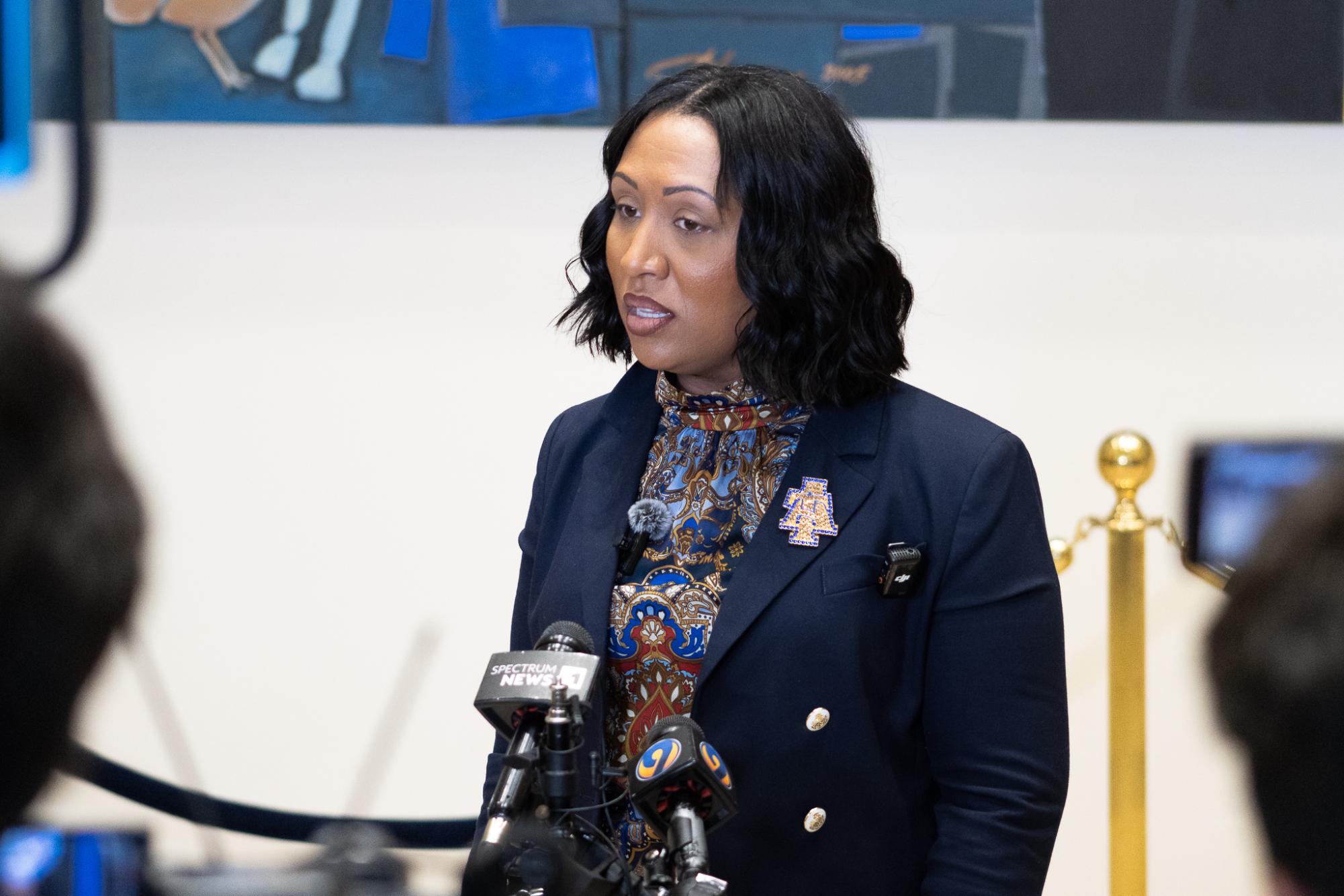
Boyce said she met and spoke with Jackson several times and felt honored to have shared a relationship with such a prominent figure in A&T’s history.
“His impact on this campus made us very, very proud that he was an Aggie, but then he took that on a national stage,” she said.
A&T Chancellor, James R. Martin II, said he had planned to visit Jackson in Chicago, Illinois, within the coming week, before the news of Jackson’s death reached him.
“I wanted to just be in his presence,” he said. “It wasn’t one thing that I wanted to say. It was about just feeling his spirit, his energy, and just telling him thank you, and about how inspiring his work has been.”
Born Oct. 8, 1941, in Greenville, S.C., Jackson lived out his childhood in an American society plagued by the unfair standards of Jim Crow and segregated institutions.
Jackson’s efforts to advocate for justice for over seven decades saw its first spark in 1960 when a then college freshman Jackson led a group of high-schoolers — later deemed the Greenville Eight — in conducting a peaceful “read-in” at the city’s segregated library. All eight students were subsequently arrested and charged with disorderly conduct.
Jackson began his collegiate studies at the University of Illinois while on a football scholarship prior to transferring to A&T, where he graduated with a B.S. in sociology in 1964.
Several A&T students were deeply moved by the news of losing such a beloved alum, including Olu Rouse, one of the co-founders of Protect Ours, a student-led movement meant to get students from campus to the voting polls.
“When social justice figures like Rev. Jackson die, people tend to form the idea in their head that the Civil Rights Movement was long ago and that we are past fighting for justice,” Rouse said. “However, I think it’s essential that everyone realizes that we are still fighting similar fights today against voting and racial injustice.”
Rouse and co-founder of Protect Ours, Shia Rozier, have organized a shuttle pickup schedule to transport students to voting polls, following on-campus polling removals across the state.
During his time at A&T, Jackson participated in sit-ins following the Greensboro Four’s demonstration in the now-memorialized Woolworth store, served as the student body president in 1960 and 1964, and was a quarterback for the A&T football team, which he led to a CIAA championship in 1964.
It was also on the campus of A&T that Jackson met Jacqueline Lavinia Brown, whom he married in 1962. The two have five children together.
He also had a daughter, Ashley Laverne Jackson, with Karin Stanford in 1999. Ashley Jackson became an actress, writer, and producer for T.V. and film.
Shortly after his graduation, Jackson first encountered legendary civil rights leader and Nobel Peace Prize recipient, Dr. Martin Luther King Jr., whom he accompanied in the Selma-Montgomery marches. Following King’s assassination in 1968, to which Jackson was an eyewitness, his involvement in activism-based organizations steadily increased year after year.
Jackson led organizations and movements such as the Southern Christian Leadership Conference, Operation PUSH (People United to Save Humanity), the Rainbow PUSH Coalition, the anti-Apartheid movement in South Africa, and anti-war demonstrations in London.
Jackson was responsible for the successful release of a U.S. Navy pilot from Syrian forces, 48 Americans held prisoner in Cuba and U.S. citizens held by the Iraqi government prior to the first Gulf War.
Jackson also ran for president in 1984 and 1988, amassing almost seven million votes in his second campaign. While he wasn’t able to reach the final round of elections in either year, historians credit his campaigns as having a major influence on the rule changes on delegate requirements, paving the way for former President Barack Obama’s victory in 2008.
Jackson’s legacy is also cemented in his abilities as an orator, especially for his memorable hour-long speech at the 1988 Democratic National Convention and his “I Am Somebody” slogan, with which he would often conclude his speeches.
Martin said that the university will be in discussions with the family while searching for the best way to honor and memorialize Jackson’s legacy at N.C. A&T and in the nation as an activist.